An e-invoice is more than a document. It is data in motion.
Electronic invoicing moves structured, machine-readable invoice data between business systems for validation, exchange and processing. This guide follows one invoice as a record through those systems, so each decision can be checked at the stage where it is made.
Explore the relationships between supplier systems, formats, exchange routes, buyer systems and country rules.
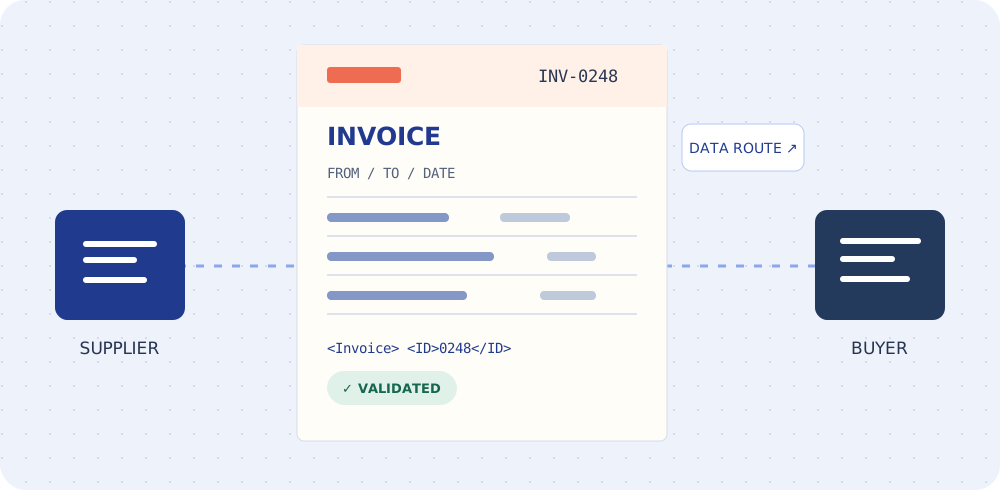
Follow the invoice, not just the file.
Each hand-off can affect whether the receiving organisation can actually process an invoice.
Create
Capture invoice information in a business system.
Map
Represent the fields in an agreed model and syntax.
Validate
Check structure, calculations and business rules.
Route
Send through the accepted channel to the recipient.
Process
Receive, match, reconcile and handle exceptions.
Find your starting point.
Move from the basic concepts to the systems and decisions that make an exchange work. Start with the pillar guide, then open the topic that matches your stage.
E-invoicing explained: structured invoices, mandates, formats and software →
The visible invoice is only one layer.
Underneath a human-readable invoice are fields, references and validation rules. Reliable exchange depends on preserving their meaning as information passes between systems.
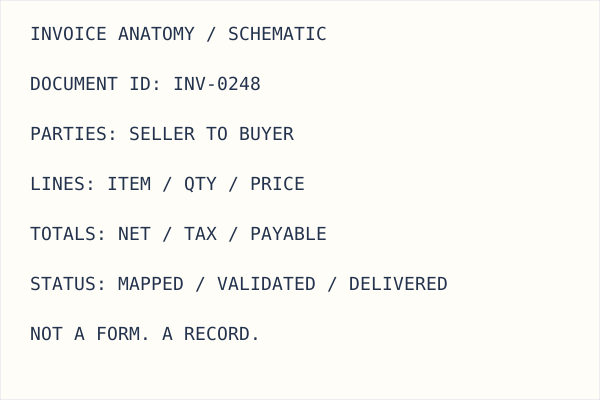
Read the record, field by field.
Before asking whether a format is accepted, read what the invoice carries: its identifier, its parties, its lines, its totals and its status. If one of those is missing or ambiguous, no route can repair it later.
Guides for the next decision.
E-invoicing explained: structured invoices, mandates, formats and software
A practical introduction to e-invoicing, including structured invoice data, mandate models, invoice formats, delivery networks, validation, tax reporting, accounting workflows and software.
Structured vs readable documents explained: PDF, hybrid and structured compared
The pillar for document forms: what each form carries, what a system can do with it, and where each one breaks.
Invoice data fields and master data: the complete field guide
Parties, lines, totals, references and identifiers, and the master data that keeps them consistent across systems.
EN 16931 semantic model explained: meaning before syntax
The European standard for the core invoice model, its business terms, business rules and the separation of meaning from encoding.
Syntaxes and formats explained: UBL, CII and national formats
How the same semantic model is encoded in different syntaxes, and how to choose without confusing syntax with meaning.
Networks and access points explained: how an invoice is routed
Direct exchange, providers, platforms and the Peppol network, compared by addressing, acknowledgement and responsibility.